 简体中文
 English (US)
 Bahasa Melayu
 العربية
 Français
 Русский
 Español
 Tiếng Việt
 繁體中文
简体中文English (US)Bahasa MelayuالعربيةFrançaisРусскийEspañolTiếng Việt繁體中文
Key Points: An electric arc, simply put, is electricity "jumping" like a spark. Under normal conditions, current flows steadily along the wire, but when wire insulation ages or becomes damaged, or when connections come loose or make poor contact, the current takes "the road less traveled"—leaping across an air gap and forming a bright spark. That's what an electric arc is.
An electric arc, simply put, is current "jumping the gap." Under normal conditions, current should travel obediently along the conductor, but when wire insulation ages or is damaged, or when connections loosen and make poor contact, the current "takes an unusual path"—jumping across the air gap and forming a bright spark. This is an electric arc.

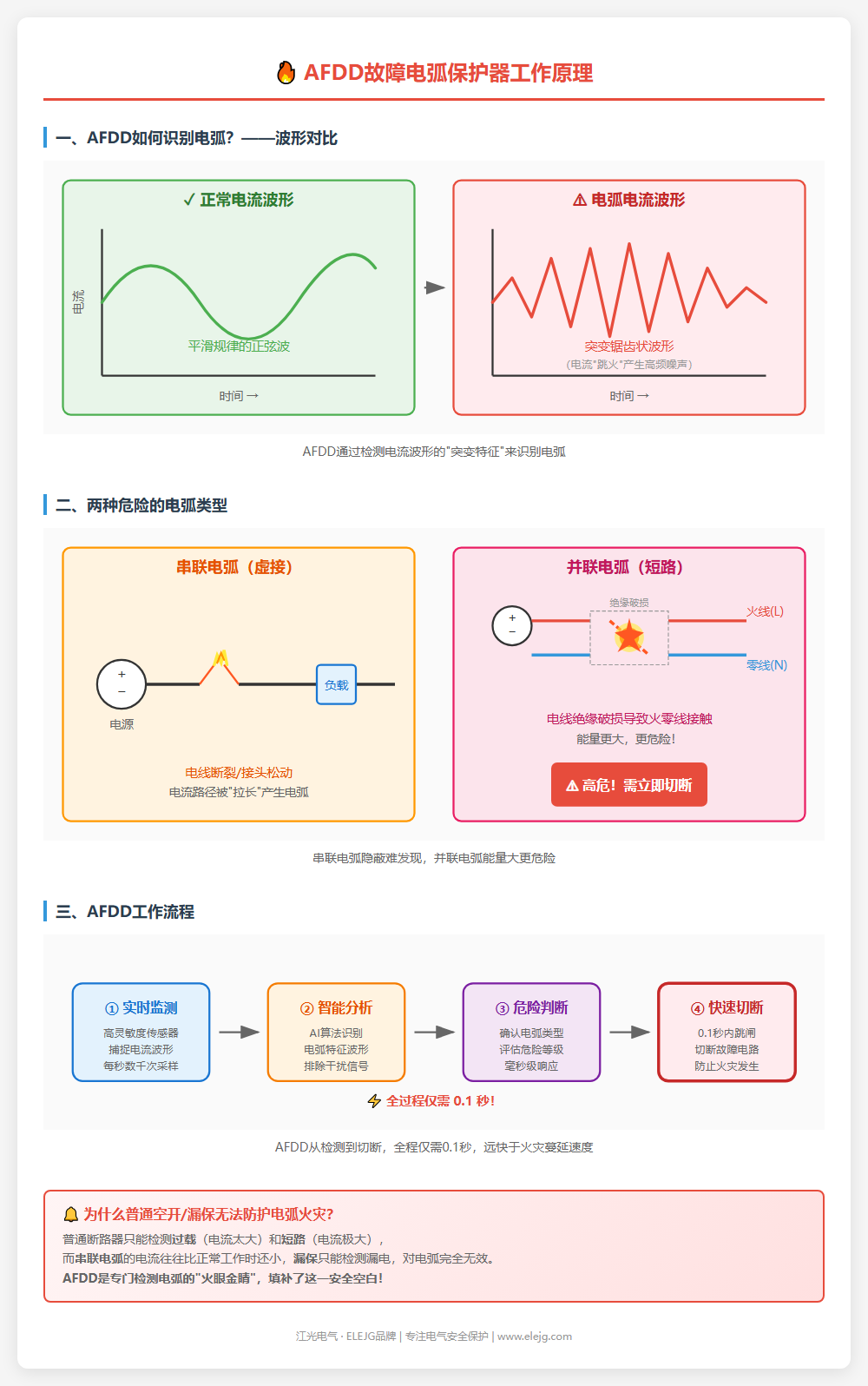
The temperature of an electric arc is extremely high, with the core temperature reaching over 3000°C—hotter than welding! It can instantly ignite nearby combustibles such as wood, fabric, and plastic. According to statistics, a significant portion of electrical fires are caused by arc faults. Even more alarming, series arcs (loose connections in a circuit) carry very little current, so ordinary circuit breakers cannot detect them at all—yet the fire hazard is very real.
An AFDD (Arc Fault Detection Device) is like the "all-seeing eye" of a circuit. It has a built-in high-sensitivity sensor that monitors the current waveform in real time. A normal current waveform is smooth and regular, while an arc current shows sudden, "sawtooth" changes. Through intelligent algorithms that analyze these waveform characteristics, the AFDD can identify a dangerous arc within milliseconds and quickly cut off the power supply.
Series arc: Occurs on the same conductor, such as an internal break in a wire or a loose connection. The current path is "stretched," forming an arc.
Parallel arc: Occurs between the live wire and the neutral wire, such as when damaged wire insulation causes the two wires to touch. This type of arc has more energy and is more dangerous.
AFDDs can effectively detect and protect against both types of arcs.
Old-style circuit breakers and residual current devices can only protect against overload, short circuits, and leakage currents—they are powerless against arc fires. AFDDs specifically fill this safety gap and are especially suitable for older homes, wooden houses, and families using high-power appliances. Installing an AFDD is like adding a "firewall" to your circuit, letting your family sleep more soundly.
Copyright © 2018-2020 Wenzhou Jiangguang Electrical Technology Co., Ltd. All Rights Reserved. Zhejiang Icp Record No. 15019439-3